Thursday, June 23, 2011

In Saxony

Greetings from modern Saxony (Sachsen in German) (http://en.wikipedia.org/wiki/Saxony) where Gertrud and I have just spend a very enjoyable week with friends. The Saxons were one of the best known of the Germanic tribes and had significant impact on Northern Europe and on the British Isles.  Ancient Saxony was much larger and included parts of today's German states of Westphalia, Lower Saxony, Saxon and Saxon-Anhalt the last two of which were created in the 1990's after German reunification.  Cities visited on this trip have included Dresden, Leipzig, Meissen, Moritzburg and Halle an der Saale.


Dresden, Saxon's capital, is best known today for the heavy and extremely controversial bombings it suffered from American and British Forces towards the end of World War II (http://en.wikipedia.org/wiki/Bombing_of_Dresden_in_World_War_II).   It had long been a cultural center of Northern German.  For most of the war, the Allies had not considered Dresden as strategically important and seemed hesitant to destroy it.  What caused them to carry out these bombings at war's end is still the subject of much speculation.  Estimates of the numbers killed range from 35,000 to 135,000 which included many refugees moving westward to avoid the advancing Red Army.


But like the legendary Phoenix, Dresden has risen up from its ashes to again become one of Germany most beautiful cities. Restored buildings include the Zwinger Palace (http://en.wikipedia.org/wiki/Zwinger,) Das Grüne Gewolbe, which houses many treasures of Saxon's rulers (http://www.skd.museum/en/museums-institutions/residenzschloss/gruenes-gewoelbe/index.html), and the exquisite baroque Frauenkirche (church of our lady) (http://en.wikipedia.org/wiki/Dresden_Frauenkirche).  Gertrud and I were in Dresden in June 2004 and were able to watch as large cranes lifted the new cupola onto the top of the church, completing its restoration.  The cupola was a gift from the British as a token of restored friendship between the two countries.


Leipzig (http://en.wikipedia.org/wiki/Leipzig) has regained much of its pre-WWII luster as a center of trade fairs, education and culture.  Johann Sebastian Bach is buried in the city's Thomaskirche where he also spent many years as the church's cantor. Other personalities who performed or preached in the Thomaskirche were Mozart, Richard Wagner and Martin Luther. (http://en.wikipedia.org/wiki/St._Thomas_Church,_Leipzig). In the late 1980s, weekely monday demonstrations emanating from Leipzig's Nicolikirche became a major factor in bringing about the collapse of the former Communist Government of East Germany (http://en.wikipedia.or/wiki/Monday_demonstrations_in_East_Germany). We also had dinner in Leipzig's famous Auerbach's Keller 
(http://en.wikipedia.org/wiki/Auerbachs_Keller) which played a key role in Johann Wolfgang von Goethe's novel Faust.  And as a final comment, one of Germany's largest monuments, the Volkerslacht Denkmal
(http://en.wikipedia.org/wiki/Monument_to_the_Battle_of_the_Nations) commemorates Napoleon's 1813 defeat at Leipzig. Approximately 600,000 troops fought in this battle and an estimated 90,000 died in the surrounding fields. 


Halle was founded in the 9th Century and is the birthplace of Georg Friedric Händel. Meissen is often called the "Cradle of Saxony" and is famous for its porcelain. (http://en.wikipedia.org/wiki/Meissen).  Moritzburg Castle was built in the 1500s as a hunting lodge (http://en.wikipedia.org/wiki/Schloss_Moritzburg).  

Tuesday, June 14, 2011

Grüsse aus Franken

Gertrud and I are currently on our annual "pilgrimage" to Franken, or Franconia in English (http://en.wikipedia.org/wiki/Franconia).  It is in the Northern part of the State of Bavaria in Germany and is her heimat\homeland where she still has family and friends.  While this area is not as famous as Munich and the Alps of Upper Bavaria, we think Franconia's medieval cities are much prettier and more interesting than those in the South.  This year we have been joined by American friends Reed and Carol Warnick on visits to Bamberg (http://en.wikipedia.org/wiki/Bamberg) which Bill Clinton said was the most beautiful city he had ever visited; the baroque Basilica and impressive Catholic pilgrimage site of the Vierzehnheiligen (http://en.wikipedia.org/wiki/Basilica_of_the_Fourteen_Holy_Helpers); reconstructed Nuremberg which was badly bombed and is well known for the Nazi trials held there (http://en.wikipedia.org/wiki/Nuremberg) (http://www.thirdreichruins.com/nuernberg.htm); Bayreuth, famous for its annual festival of Wagnerian Operas (http://en.wikipedia.org/wiki/Bayreuth); Würzburg with a Prince-Bishop Residence dubbed by Napoleon as the nicest parsonage in Europe (http://en.wikipedia.org/wiki/W%C3%BCrzburg_Residence); and the UNESCO World Heritage City of Regensburg (http://en.wikipedia.org/wiki/Regensburg) which is not really in Franken but which is nearby and feels like its Franconian.


We also spent two nights at Pastorius Haus (http://www.pastoriushaus.org) in Gertrud's home town of Bad Windsheim.  It is named after Daniel Pastorious, a native of the area and a founder of Germantown, Pennsylvania, one of America's earliest German settlements.  With Bad Windsheim's close proximity to Germany's famous Romantic Road (http://en.wikipedia.org/wiki/Romantic_Road) we also visited Dinkelsbühl, Rothenburg ob der Tauber, Nördlingen and other beautiful villages and towns along it.

Tuesday, May 24, 2011

If its Tuesday, it must be Belgium!

Did you ever see this film from the 1960's staring Suzanne Pleshette?  It's about a group of American tourists trying to see Europe in 12 days. Gertrud and I are now in Brussels, the last of 7 stops on my European business trip,  and I feel we should be characters in this movie. 
http://www.imdb.com/title/tt0064471/


I don't have much to say about Brussels even though it is often referred to as the Capital of Europe due to its status as the seat of the European Union.  As a tourist destination, it can't begin to compare with Paris, Madrid, Rome, Prague or Berlin. However it can certainly compete in the culinary sphere and in my opinion has some of the best restauruants in all of Europe.  Its seafood is especially good and it has better options for French food than one can readily find in Paris.


Belgium's top tourism destination is the ancient trading city of Bruges(http://en.wikipedia.org/wiki/Bruges) which we visited over the past weekend.  As a canal city, we prefer it to Amsterdam because it is much less crowded and the bicycles are much less threatening.

Friday, May 20, 2011

Unrest at Madrid's Puerta del Sol


Well it appears we made it out of Spain in the nick of time.  We just spend a week in Madrid and could feel the pressure building in the city's plazas for some major demonstrations just before this weekends Spanish elections. Currently Spain has a 21 percent unemployment rate, with 40 percent among the youth. This could be a recipe for serious violence in the coming days and weeks.

But we won't let this detract from our overall wonderful week and we have decided that Madrid is now one of our favorite cities. It is clean, has good weather, an excellent transportation system, great restaurants and cafes, beautiful plazas and elegant shops.  And there are lots of stimulating things to see and do in the city and in the region. For starters there are its two world famous art museums -- the Prado  (http://www.museodelprado.es/en) and the Thyssen-Bornemesza  (http://www.museothyssen.org/en/thyssen/home) which were open in the evenings (thank goodness, since I had to work during the day).

On the weekend we immersed ourselves in Spainish history and culture by visiting El Escorial (http://en.wikipedia.org/wiki/El_Escorial), Segovia (http://en.wikipedia.org/wiki/Segovia), Avila (http://en.wikipedia.org/wiki/Ávila,_Spain) and

The highlight for me was Segovia with an impressive 2000 year old aqueduct crossing through the city center, a Moorish alcazar, parts of which are said to have been copied in the castle at Disneyworld, and an imposing cathedral which towers above the city. 


Alkazar of Segovia

Segovia Cathederal

Aqueduct of Segovia


The principal attraction of Avila is the ancient wall that completely surrounds the old city.

City Wall of Avila
A visit to Toledo is essential to an understanding of Isabella and Ferdinand and their honored place in Spanish history.  From a purely Spanish and Catholic point-of-view they were the force that united modern Spain under Catholicism and for which Isabella was granted sainthood.

Toledo

They were also the ones who financed Colombus' voyage to America but who also carried out the Inquisition and drove the Moors (North African Muslims) and the Jews out of Spain with a commensurate loss of lives.  Here are a few links on Isabella and Ferdinand and on Spanish history for anyone who may be interested.


The past two weeks in Iberia have been extremely educational and nicely suplemented trips we had previous made to Andalusia and Catalonia.  But it would take many more visits to this peninsula to really understand the great impact that its people have had on the history of the world.


Wednesday, May 11, 2011

5 days in Lisbon


Lisbon isn't Paris but it does have some interesting tourist and culture attractions. The best known are the UNESCO world heritage sites of St. Jeronomo Monastery where Vasco de Gama is buried, and Belem Tower, a monument to Portugal's maritime history which stems from the 16th Century.

 
The inner city suffers from urban blight during the day and badly needs renewal. However the bars, nightclubs and restaurants come alive at night with the primary draw being Fado, the Portuguese version of the blues which developed in Lisbon's poor neighborhoods. We had dinner one evening while being entertained by fado singers  We like it ok but a little goes a long way when you don't understand Portuguese. Ironically, Gertrud and I first heard fado about 5 years ago at an outdoor international folk festival in Salt Lake.  The singer was a tall blond named Maritza who had a stunning stage presence and who it turns out is one of the biggest name in fado and known throughout Portugal.  Here is a youtube link with Maritza singing fado. 


On Saturday we visited several towns outside Lisbon including Sintra where the royal family spent its summers when it ruled Portugal.  Sintra Palace is the first palace I've seen with chimneys as the dominant feature. 

We especially enjoyed Cabo da Roca, the most Westerly point in Europe which is covered with some of the most beautiful wild flowers we have ever seen.  We also visited the elegant beach resort of Cascais and the spa of Estoril.  All of these places are within an hour of Lisbon and serve as bedroom communities for businessmen and officials who work in the city. 

On Tuesday, while I was working, Gertrud took a tour (no, not a pilgrimage) to Fatima, one of the most visited Catholic pilgrimage sites for the worship of Mary.  I took the same trip 5 years ago and was quite amazed by the devotion. The tour bus also make stops in the medieval seaside village of Obidos, in the fishing village of Nazare and the Batalha Monastery. 


Friday, May 6, 2011

Paris in the Springtime

This afternoon Gertrud and I will be departing Paris after a most wonderful week.  We have been here several times before but have never enjoyed it as much, probably because we didn't feel the pressure to see everything on this trip. Instead we took the time to relax (me, after the end of my work day) and to savor the city's ambiance and joie de vivre.  Paris in the Springtime has been a theme of writers, poets, painters and musicians for centuries, and with the flowers and trees now in bloom and the sidewalk cafes and restaurants full, we have certainly been inspired too.


Gertrud in a Paris cafe

Much of our enjoyment can be attributed to the location of the lovely boutique hotel we stayed in on Rue du Mont Thabor which is only short walks away from Place Vendome, the Opera, Place de la Concorde, the Champs Elysees, Place de la Madeleine, the Louvre, Notre Dame, the Orsay Palace, etc. On one warm evening we even walked to a restaurant near the Eiffel Tower for dinner which was only 45 minutes away.


Lobby of our hotel - Renaissance Place Vendome


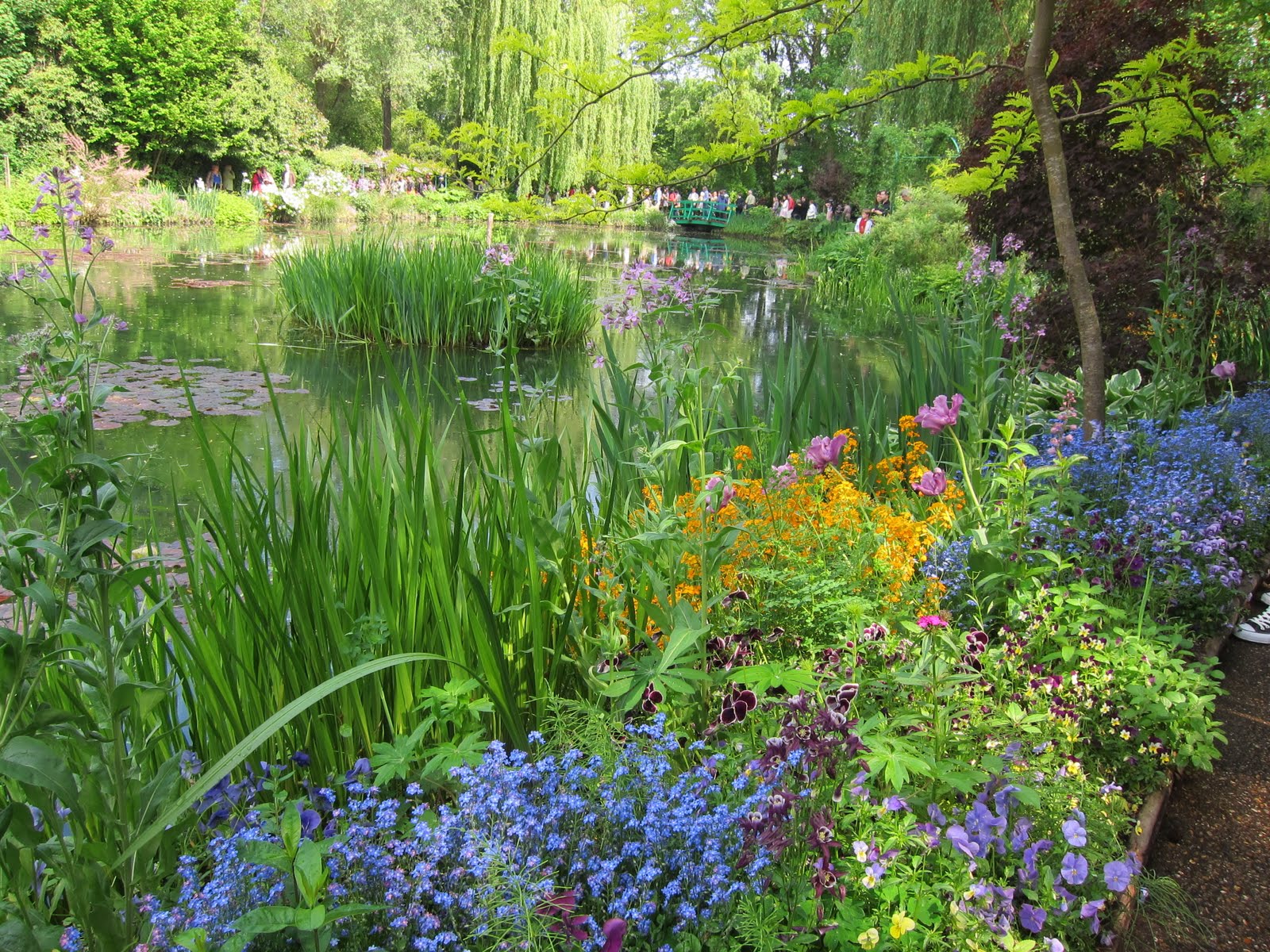
On Saturday we saw Paris from the top of a double-decker bus, and on our only excursion outside Paris, we took a half-day tour to Giverny in Normandy to see Claude Monet's home and the gardens which provided the themes for many of his famous impressionist paintings. The gardens were as beautiful as we had expected http://giverny.org/gardens/fcm/visitgb.htm.


Monet's Garden
Monet's Garden


Note to our French friend, Joelle:  yes, we now agree with you that Paris is the world's most beautiful city, especially in the Spring.

Sunday, April 24, 2011

Easter in Yerevan

Today is Easter in Armenia.  This year, Orthodox Easter, which is based on the lunar calendar, happens to fall on the same Sunday as in the Catholic and Protestant churches.  A further coincidence is that it is also on April 24th which is Armenian Genocide Commemoration Day, which by itself would be one of the most important days on the Armenian Calendar.  When I was here five years ago, an Armenian American couple told me that younger Armenians aren't very religious but that the Armenian Church is the center of their history and culture and this, together with the Armenian genocide, is what binds the Armenian Diaspora together.

This morning I decided to walk a few blocks from my hotel to an old Armenian Church to observe the Easter service. Around the church were many elderly women selling candles which were not carried into the church, but instead were lit and then consumed in fires near the entrance in remembrance of Christ.  The thought occurred to me that in previous eras the candles were probably burned inside the church but that the smoke made it difficult to breath and that it also discolored the walls and ceiling.  Some enterprising patriarch probably decided to move this ritual outside for reasons of health and historical preservation.  In Western Europe, many churches now have electric candles for the same reason and one simply pays a few cents to light the artificial candles. From an outsider perspective, the Armenia service wasn't significantly different than a Catholic Easter service, with the devout lined up in front of the priest to be blessed and to receive the sacrament. When finished, many walked around the inside of the church touching statues and paintings of the saints and crossing themselves.

The Armenian Church is one of the original Christian Churches, having arisen from underground and with Armenia having become the first state to officially adopt Christianity in 301 A.D. Since then the country and its faith have been inseparable. Also, Armenia, together with Georgia and Russia formed the Eastern frontier of historic Christianity.
 
On my previous visit I had a weekend for sightseeing, which included a half day at the "Mother Sea of Holy Etchmiadzin," the equivalent of the Catholic Church's Vatican, which I found extremely interesting. The key information about Etchmiadzin is on the Church's website at the following link: I especially recommend the pages on the Church's history and on the 132 Catholicos or patriarchs that have succeeded Gregory the Illuminator, who founded the church  http://www.armenianchurch.org/index.jsp).

On my last trip I also visited the ancient Hellenic Temple of Garni, built in the 2nd Century BC and nearby Geghard Monastery which stems from the 7th Century which are described in the following links: