Tuesday, May 24, 2011

If its Tuesday, it must be Belgium!

Did you ever see this film from the 1960's staring Suzanne Pleshette?  It's about a group of American tourists trying to see Europe in 12 days. Gertrud and I are now in Brussels, the last of 7 stops on my European business trip,  and I feel we should be characters in this movie. 
http://www.imdb.com/title/tt0064471/


I don't have much to say about Brussels even though it is often referred to as the Capital of Europe due to its status as the seat of the European Union.  As a tourist destination, it can't begin to compare with Paris, Madrid, Rome, Prague or Berlin. However it can certainly compete in the culinary sphere and in my opinion has some of the best restauruants in all of Europe.  Its seafood is especially good and it has better options for French food than one can readily find in Paris.


Belgium's top tourism destination is the ancient trading city of Bruges(http://en.wikipedia.org/wiki/Bruges) which we visited over the past weekend.  As a canal city, we prefer it to Amsterdam because it is much less crowded and the bicycles are much less threatening.

Friday, May 20, 2011

Unrest at Madrid's Puerta del Sol


Well it appears we made it out of Spain in the nick of time.  We just spend a week in Madrid and could feel the pressure building in the city's plazas for some major demonstrations just before this weekends Spanish elections. Currently Spain has a 21 percent unemployment rate, with 40 percent among the youth. This could be a recipe for serious violence in the coming days and weeks.

But we won't let this detract from our overall wonderful week and we have decided that Madrid is now one of our favorite cities. It is clean, has good weather, an excellent transportation system, great restaurants and cafes, beautiful plazas and elegant shops.  And there are lots of stimulating things to see and do in the city and in the region. For starters there are its two world famous art museums -- the Prado  (http://www.museodelprado.es/en) and the Thyssen-Bornemesza  (http://www.museothyssen.org/en/thyssen/home) which were open in the evenings (thank goodness, since I had to work during the day).

On the weekend we immersed ourselves in Spainish history and culture by visiting El Escorial (http://en.wikipedia.org/wiki/El_Escorial), Segovia (http://en.wikipedia.org/wiki/Segovia), Avila (http://en.wikipedia.org/wiki/Ávila,_Spain) and

The highlight for me was Segovia with an impressive 2000 year old aqueduct crossing through the city center, a Moorish alcazar, parts of which are said to have been copied in the castle at Disneyworld, and an imposing cathedral which towers above the city. 


Alkazar of Segovia

Segovia Cathederal

Aqueduct of Segovia


The principal attraction of Avila is the ancient wall that completely surrounds the old city.

City Wall of Avila
A visit to Toledo is essential to an understanding of Isabella and Ferdinand and their honored place in Spanish history.  From a purely Spanish and Catholic point-of-view they were the force that united modern Spain under Catholicism and for which Isabella was granted sainthood.

Toledo

They were also the ones who financed Colombus' voyage to America but who also carried out the Inquisition and drove the Moors (North African Muslims) and the Jews out of Spain with a commensurate loss of lives.  Here are a few links on Isabella and Ferdinand and on Spanish history for anyone who may be interested.


The past two weeks in Iberia have been extremely educational and nicely suplemented trips we had previous made to Andalusia and Catalonia.  But it would take many more visits to this peninsula to really understand the great impact that its people have had on the history of the world.


Wednesday, May 11, 2011

5 days in Lisbon


Lisbon isn't Paris but it does have some interesting tourist and culture attractions. The best known are the UNESCO world heritage sites of St. Jeronomo Monastery where Vasco de Gama is buried, and Belem Tower, a monument to Portugal's maritime history which stems from the 16th Century.

 
The inner city suffers from urban blight during the day and badly needs renewal. However the bars, nightclubs and restaurants come alive at night with the primary draw being Fado, the Portuguese version of the blues which developed in Lisbon's poor neighborhoods. We had dinner one evening while being entertained by fado singers  We like it ok but a little goes a long way when you don't understand Portuguese. Ironically, Gertrud and I first heard fado about 5 years ago at an outdoor international folk festival in Salt Lake.  The singer was a tall blond named Maritza who had a stunning stage presence and who it turns out is one of the biggest name in fado and known throughout Portugal.  Here is a youtube link with Maritza singing fado. 


On Saturday we visited several towns outside Lisbon including Sintra where the royal family spent its summers when it ruled Portugal.  Sintra Palace is the first palace I've seen with chimneys as the dominant feature. 

We especially enjoyed Cabo da Roca, the most Westerly point in Europe which is covered with some of the most beautiful wild flowers we have ever seen.  We also visited the elegant beach resort of Cascais and the spa of Estoril.  All of these places are within an hour of Lisbon and serve as bedroom communities for businessmen and officials who work in the city. 

On Tuesday, while I was working, Gertrud took a tour (no, not a pilgrimage) to Fatima, one of the most visited Catholic pilgrimage sites for the worship of Mary.  I took the same trip 5 years ago and was quite amazed by the devotion. The tour bus also make stops in the medieval seaside village of Obidos, in the fishing village of Nazare and the Batalha Monastery. 


Friday, May 6, 2011

Paris in the Springtime

This afternoon Gertrud and I will be departing Paris after a most wonderful week.  We have been here several times before but have never enjoyed it as much, probably because we didn't feel the pressure to see everything on this trip. Instead we took the time to relax (me, after the end of my work day) and to savor the city's ambiance and joie de vivre.  Paris in the Springtime has been a theme of writers, poets, painters and musicians for centuries, and with the flowers and trees now in bloom and the sidewalk cafes and restaurants full, we have certainly been inspired too.


Gertrud in a Paris cafe

Much of our enjoyment can be attributed to the location of the lovely boutique hotel we stayed in on Rue du Mont Thabor which is only short walks away from Place Vendome, the Opera, Place de la Concorde, the Champs Elysees, Place de la Madeleine, the Louvre, Notre Dame, the Orsay Palace, etc. On one warm evening we even walked to a restaurant near the Eiffel Tower for dinner which was only 45 minutes away.


Lobby of our hotel - Renaissance Place Vendome


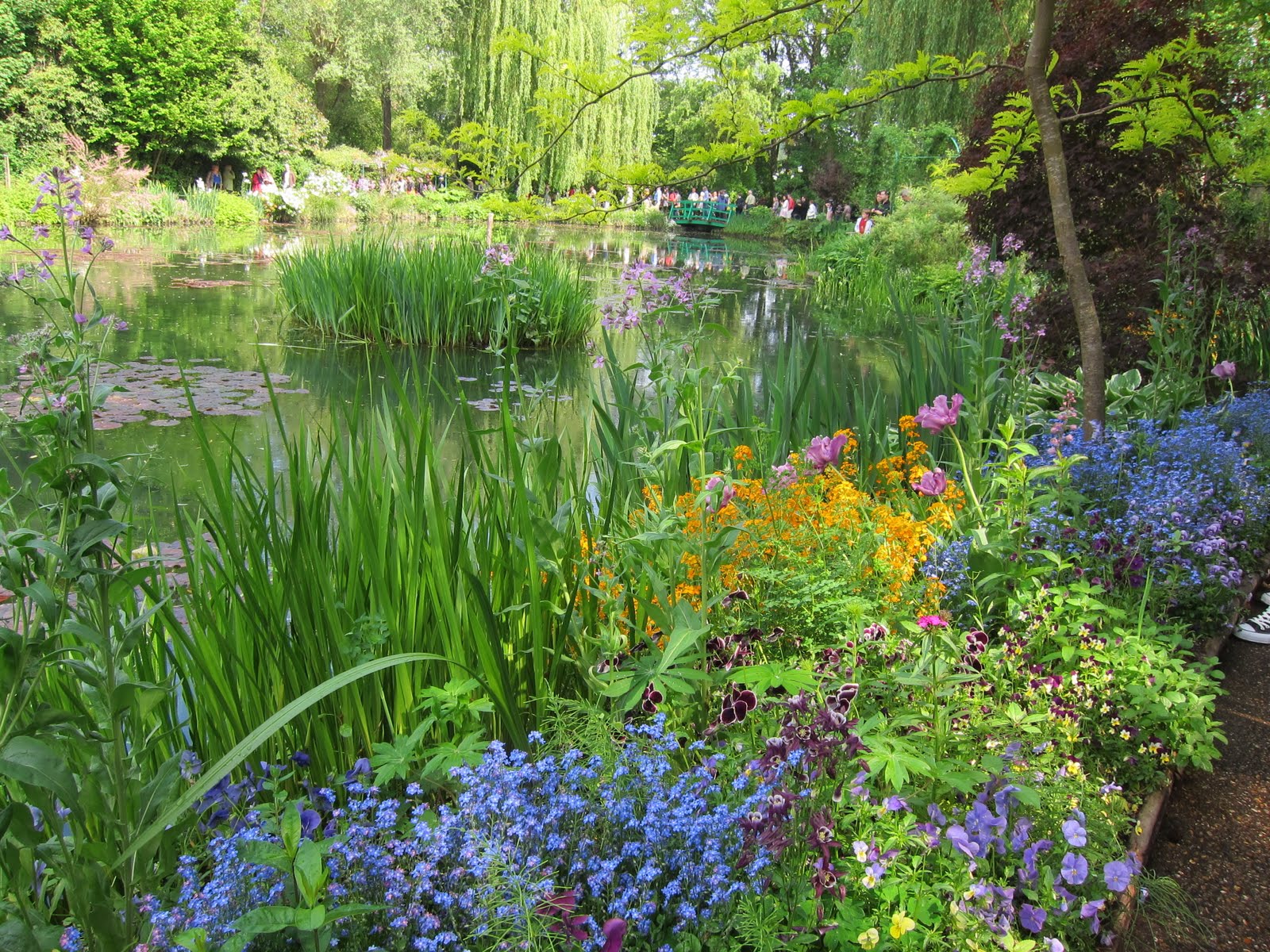
On Saturday we saw Paris from the top of a double-decker bus, and on our only excursion outside Paris, we took a half-day tour to Giverny in Normandy to see Claude Monet's home and the gardens which provided the themes for many of his famous impressionist paintings. The gardens were as beautiful as we had expected http://giverny.org/gardens/fcm/visitgb.htm.


Monet's Garden
Monet's Garden


Note to our French friend, Joelle:  yes, we now agree with you that Paris is the world's most beautiful city, especially in the Spring.

Sunday, April 24, 2011

Easter in Yerevan

Today is Easter in Armenia.  This year, Orthodox Easter, which is based on the lunar calendar, happens to fall on the same Sunday as in the Catholic and Protestant churches.  A further coincidence is that it is also on April 24th which is Armenian Genocide Commemoration Day, which by itself would be one of the most important days on the Armenian Calendar.  When I was here five years ago, an Armenian American couple told me that younger Armenians aren't very religious but that the Armenian Church is the center of their history and culture and this, together with the Armenian genocide, is what binds the Armenian Diaspora together.

This morning I decided to walk a few blocks from my hotel to an old Armenian Church to observe the Easter service. Around the church were many elderly women selling candles which were not carried into the church, but instead were lit and then consumed in fires near the entrance in remembrance of Christ.  The thought occurred to me that in previous eras the candles were probably burned inside the church but that the smoke made it difficult to breath and that it also discolored the walls and ceiling.  Some enterprising patriarch probably decided to move this ritual outside for reasons of health and historical preservation.  In Western Europe, many churches now have electric candles for the same reason and one simply pays a few cents to light the artificial candles. From an outsider perspective, the Armenia service wasn't significantly different than a Catholic Easter service, with the devout lined up in front of the priest to be blessed and to receive the sacrament. When finished, many walked around the inside of the church touching statues and paintings of the saints and crossing themselves.

The Armenian Church is one of the original Christian Churches, having arisen from underground and with Armenia having become the first state to officially adopt Christianity in 301 A.D. Since then the country and its faith have been inseparable. Also, Armenia, together with Georgia and Russia formed the Eastern frontier of historic Christianity.
 
On my previous visit I had a weekend for sightseeing, which included a half day at the "Mother Sea of Holy Etchmiadzin," the equivalent of the Catholic Church's Vatican, which I found extremely interesting. The key information about Etchmiadzin is on the Church's website at the following link: I especially recommend the pages on the Church's history and on the 132 Catholicos or patriarchs that have succeeded Gregory the Illuminator, who founded the church  http://www.armenianchurch.org/index.jsp).

On my last trip I also visited the ancient Hellenic Temple of Garni, built in the 2nd Century BC and nearby Geghard Monastery which stems from the 7th Century which are described in the following links:

Friday, April 22, 2011

Life in the former Yugoslavia


This week I've been in Belgrade, capital of what used to be Yugoslavia and now capital of Serbia.  I've been in the region many times before but the political boundaries have changed so often in recent years that it is difficult to keep up. Whereas the entire area was formerly the country of Yugoslavia, today it is Serbia, Croatia, Slovenia, Bosnia and Herzegovina, Montenegro, Macedonia and Kosovo with their respective capitals of Belgrade Zagreb, Ljubljana, Sarajevo, Podgorica, Skopje and Pristina. (http://www.cftech.com/BrainBank/GEOGRAPHY/FormerYugoslavia.html). You have no doubt heard the term Balkanization: well this is what it means. The last three of these countries, plus Belarus, are the only European countries I haven't yet visited.

All of the Balkan countries are struggling to varying degrees to throw off the shackles of their former dictators and their communist economic systems. Most soviet-era factories stand empty and free market principles are still trying to take hold. Most people still reside in large tenements apartment and would either like to move elsewhere or are hoping that things will miraculously change overnight at home.

While Belgrade has a few charming areas and a lot of construction going on, the overall impression is still gray and drab. Old buildings which could be grand, look tired and are in need of plaster and paint. Sidewalks need repair and most shops don't entice.  The primary tourist destination is the Kalemengan Fortress (http://www.belgradeeye.com/kalemegdan.html) which overlooks the confluence of the Sava River into the Danube and is quite interesting.  For cafe society, common throughout the Balkans, the downtown pedestrian zone has some appealing tables where one can sit, sip, chat and ogle for hours for only a few dinar. And the Skadarlija bohemian area has some good restaurants and an upbeat atmosphere with numerous small orchestras playing Gypsy and Eastern European music for tips.

But there are other cities and areas in the former Yugoslavia that I much prefer to Belgrade. The most attractive cities for tourists are of course those along the beautiful Dalmatian Coast of Croatia such as Zadar, Split and Dubrovnik.  Tourists swarm from Northern Europe to these ancient cities and nearby resorts that begin in Istria just Sourth of Trieste and run all the way down to Dubrovnik.  And well-healed Europeans, and even a few Americans I know, have their eyes on Dalmatian properties for their retirement years, and are thereby driving up the prices.      


Slovenia has had the greatest success in becoming main stream Europe and its Alps are a great holiday destination for lovers of mountains and nature.  Gertrud and I spend a week there last summer and fell in love with Bled.  We were in a wonderful small hotel with a balcony overlooking Bled Lake and had a hard time leaving because it was so romantic and tranquil. 


Lake Bled from our hotel window

In 2002, shortly after I retired from the Foreign Service, I was asked to return to the service for two months to fill a staffing gap at Embassy Sarajevo.  I thoroughly enjoyed this short working vacation and became very attached to Sarajevo which had such a proud history of religious tolerance before World War I (Sarajevo is where Prince Ferdinand of Austria was killed to start the war) and such an unfortunate history after the break up of Yugoslavia  (http://en.wikipedia.org/wiki/Sarajevo). Both Serbia and Croatia coveted Bosnia and Herzegovina to further their own national ambitions.  Lovely Mostar in Herzegovina with its famous bridge is also a wonderful city that has apparently risen up out of the ashes of the war.  Gertrud and I visited it during the late 1960s shortly after we were married and I visited it again from Sarajevo in 2002 to see the war damage to the city and bridge. 
 

Saturday, April 16, 2011

The "Turkish Republic of Northern Cyprus"

Yesterday, in conjunction with work in Nicosia, I made my first ever visit to "the Turkish Republic of Northern Cyprus" which is only recognized as such by Turkish Cypriots and the Country of Turkey.  The rest of the international community considers the entire Island to be the Republic of Cyprus (ROC), evidenced by the fact that the ROC has been granted membership in both the United Nations and the European Union. Most Cypriots simply refer to the disputed area as "the North" which comprises about a third of the country and which depends heavily on Turkey for political, military and economic support.   However an estimated 30,000 Turkish Cypriots commute between the North and Greek-speaking Cyprus each day and are paid in Euros. 

The North is separated from the rest of Cyprus by a buffer (called the green zone) which also runs through Nicosia  The North's flag is usually flown in tandem with the Turkish flag. There is a large replica of it on one of the mountains in the Kyrenia Range where it can be seen from long distances to serve as a symbol of Northern pride.

The only routes in and out of Northern Cyprus are via boat or plane from Turkey or through one of several crossing points from Southern Cyprus. I crossed at the Nicosia check point and expected that it would be much like it was to cross from West Berlin into East Berlin at Check Point Charlie in the 1980s.  It turned out to be much easier, perhaps because I was in a vehicle with US Embassy plates. When we approached the barrier we simply held up our passports and they waved us through. The North looks pretty much like the South with the most obvious differences being the flying of the Northern Cyprus and Turkish flags and shop signs with Turkish language and Turkish Lira prices.  The North has some beautiful mountain trekking destinations and beach resorts which are popular with Turkish tourists. The following link discusses the problem of Cypriot identify for ethnic Turks and contains a photography of the gigantic replica of the Northern flag

http://www.cafebabel.co.uk/article/33063/national-identity-cyprus-turkish-greek-facts.html

Since the Internet contains a great deal of information on the wars and politics of Cyprus, I won't bother to go into it and will instead refer yo to the following links. The first one from YouTube focuses is on
the buffer zone and shows some of the ruins still there from the 1974 war.  The US Government still has ownership claims on some ruined properties in this area.

http://www.youtube.com/watch?v=H7CbIYGhWSA&feature=related

http://en.wikipedia.org/wiki/Northern_Cyprus


https://www.cia.gov/library/publications/the-world-factbook/geos/cy.html
With regards to the history and culture of the island, I was here about 5 years ago and had time to visit some of the island's ancient sites. Among the highlights were communities in the Trodos Mountains where there are 10 Byzantine churches on the UNESCO world heritage list.  Kykkos Monastery, the best known of the many Greek Orthodox monasteries in Cyprus, is also located in these mountains.  Former Archbishop Makarios who was also the first president of Cyprus, was an apprentice priest in this monastery and was buried at Throni which overlooks Kykkos. The island's combination of beautiful beaches and fascinating history makes is a beloved tourist destination for many Europeans, especially the Greeks and the British who colonized it in the 1800s at the behest of the Ottoman Government. Below is the official tourism site for Cyprus.


http://visitcyprus.com/wps/portal