Friday, May 6, 2011

Paris in the Springtime

This afternoon Gertrud and I will be departing Paris after a most wonderful week.  We have been here several times before but have never enjoyed it as much, probably because we didn't feel the pressure to see everything on this trip. Instead we took the time to relax (me, after the end of my work day) and to savor the city's ambiance and joie de vivre.  Paris in the Springtime has been a theme of writers, poets, painters and musicians for centuries, and with the flowers and trees now in bloom and the sidewalk cafes and restaurants full, we have certainly been inspired too.


Gertrud in a Paris cafe

Much of our enjoyment can be attributed to the location of the lovely boutique hotel we stayed in on Rue du Mont Thabor which is only short walks away from Place Vendome, the Opera, Place de la Concorde, the Champs Elysees, Place de la Madeleine, the Louvre, Notre Dame, the Orsay Palace, etc. On one warm evening we even walked to a restaurant near the Eiffel Tower for dinner which was only 45 minutes away.


Lobby of our hotel - Renaissance Place Vendome


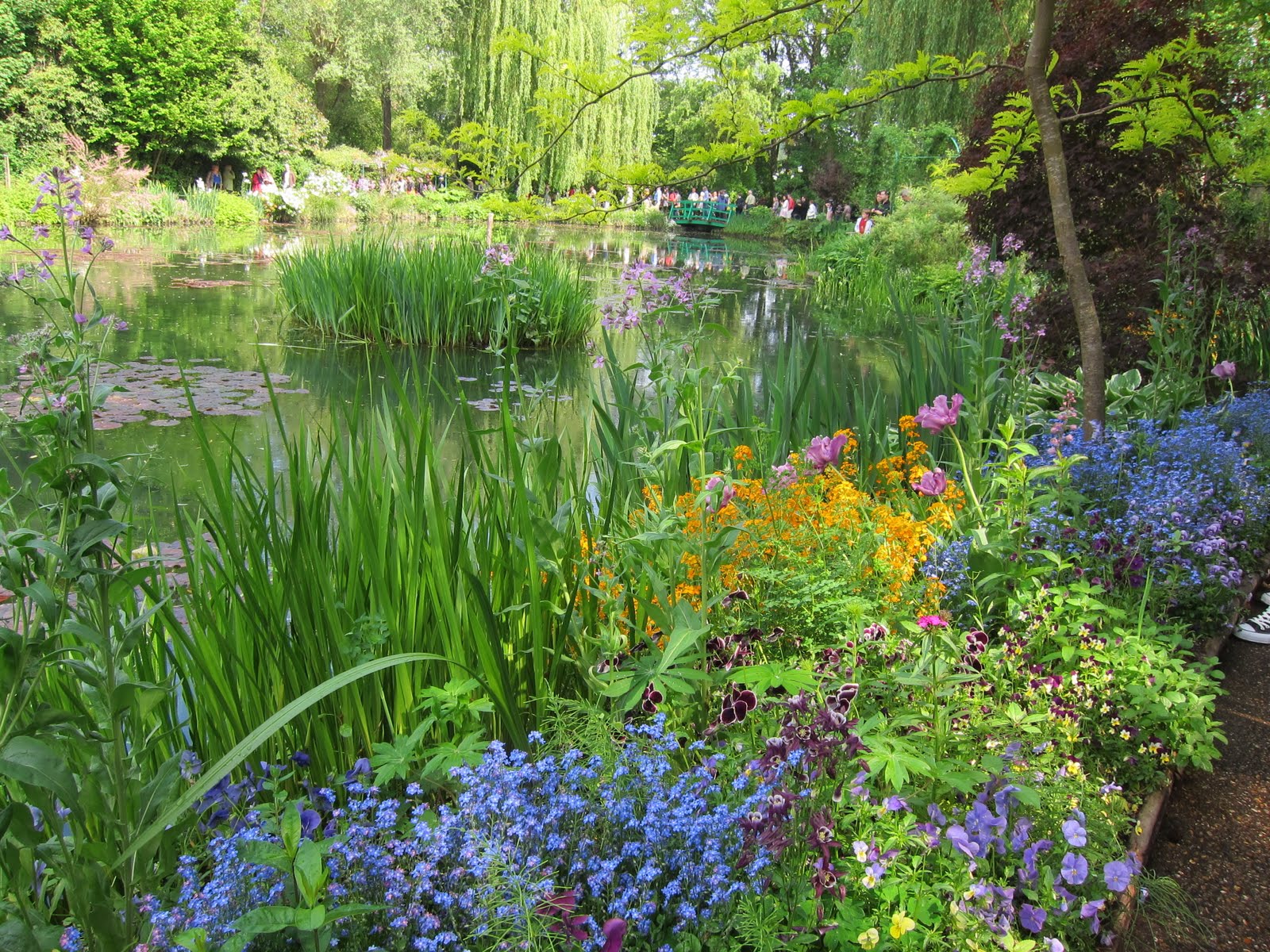
On Saturday we saw Paris from the top of a double-decker bus, and on our only excursion outside Paris, we took a half-day tour to Giverny in Normandy to see Claude Monet's home and the gardens which provided the themes for many of his famous impressionist paintings. The gardens were as beautiful as we had expected http://giverny.org/gardens/fcm/visitgb.htm.


Monet's Garden
Monet's Garden


Note to our French friend, Joelle:  yes, we now agree with you that Paris is the world's most beautiful city, especially in the Spring.

Sunday, April 24, 2011

Easter in Yerevan

Today is Easter in Armenia.  This year, Orthodox Easter, which is based on the lunar calendar, happens to fall on the same Sunday as in the Catholic and Protestant churches.  A further coincidence is that it is also on April 24th which is Armenian Genocide Commemoration Day, which by itself would be one of the most important days on the Armenian Calendar.  When I was here five years ago, an Armenian American couple told me that younger Armenians aren't very religious but that the Armenian Church is the center of their history and culture and this, together with the Armenian genocide, is what binds the Armenian Diaspora together.

This morning I decided to walk a few blocks from my hotel to an old Armenian Church to observe the Easter service. Around the church were many elderly women selling candles which were not carried into the church, but instead were lit and then consumed in fires near the entrance in remembrance of Christ.  The thought occurred to me that in previous eras the candles were probably burned inside the church but that the smoke made it difficult to breath and that it also discolored the walls and ceiling.  Some enterprising patriarch probably decided to move this ritual outside for reasons of health and historical preservation.  In Western Europe, many churches now have electric candles for the same reason and one simply pays a few cents to light the artificial candles. From an outsider perspective, the Armenia service wasn't significantly different than a Catholic Easter service, with the devout lined up in front of the priest to be blessed and to receive the sacrament. When finished, many walked around the inside of the church touching statues and paintings of the saints and crossing themselves.

The Armenian Church is one of the original Christian Churches, having arisen from underground and with Armenia having become the first state to officially adopt Christianity in 301 A.D. Since then the country and its faith have been inseparable. Also, Armenia, together with Georgia and Russia formed the Eastern frontier of historic Christianity.
 
On my previous visit I had a weekend for sightseeing, which included a half day at the "Mother Sea of Holy Etchmiadzin," the equivalent of the Catholic Church's Vatican, which I found extremely interesting. The key information about Etchmiadzin is on the Church's website at the following link: I especially recommend the pages on the Church's history and on the 132 Catholicos or patriarchs that have succeeded Gregory the Illuminator, who founded the church  http://www.armenianchurch.org/index.jsp).

On my last trip I also visited the ancient Hellenic Temple of Garni, built in the 2nd Century BC and nearby Geghard Monastery which stems from the 7th Century which are described in the following links:

Friday, April 22, 2011

Life in the former Yugoslavia


This week I've been in Belgrade, capital of what used to be Yugoslavia and now capital of Serbia.  I've been in the region many times before but the political boundaries have changed so often in recent years that it is difficult to keep up. Whereas the entire area was formerly the country of Yugoslavia, today it is Serbia, Croatia, Slovenia, Bosnia and Herzegovina, Montenegro, Macedonia and Kosovo with their respective capitals of Belgrade Zagreb, Ljubljana, Sarajevo, Podgorica, Skopje and Pristina. (http://www.cftech.com/BrainBank/GEOGRAPHY/FormerYugoslavia.html). You have no doubt heard the term Balkanization: well this is what it means. The last three of these countries, plus Belarus, are the only European countries I haven't yet visited.

All of the Balkan countries are struggling to varying degrees to throw off the shackles of their former dictators and their communist economic systems. Most soviet-era factories stand empty and free market principles are still trying to take hold. Most people still reside in large tenements apartment and would either like to move elsewhere or are hoping that things will miraculously change overnight at home.

While Belgrade has a few charming areas and a lot of construction going on, the overall impression is still gray and drab. Old buildings which could be grand, look tired and are in need of plaster and paint. Sidewalks need repair and most shops don't entice.  The primary tourist destination is the Kalemengan Fortress (http://www.belgradeeye.com/kalemegdan.html) which overlooks the confluence of the Sava River into the Danube and is quite interesting.  For cafe society, common throughout the Balkans, the downtown pedestrian zone has some appealing tables where one can sit, sip, chat and ogle for hours for only a few dinar. And the Skadarlija bohemian area has some good restaurants and an upbeat atmosphere with numerous small orchestras playing Gypsy and Eastern European music for tips.

But there are other cities and areas in the former Yugoslavia that I much prefer to Belgrade. The most attractive cities for tourists are of course those along the beautiful Dalmatian Coast of Croatia such as Zadar, Split and Dubrovnik.  Tourists swarm from Northern Europe to these ancient cities and nearby resorts that begin in Istria just Sourth of Trieste and run all the way down to Dubrovnik.  And well-healed Europeans, and even a few Americans I know, have their eyes on Dalmatian properties for their retirement years, and are thereby driving up the prices.      


Slovenia has had the greatest success in becoming main stream Europe and its Alps are a great holiday destination for lovers of mountains and nature.  Gertrud and I spend a week there last summer and fell in love with Bled.  We were in a wonderful small hotel with a balcony overlooking Bled Lake and had a hard time leaving because it was so romantic and tranquil. 


Lake Bled from our hotel window

In 2002, shortly after I retired from the Foreign Service, I was asked to return to the service for two months to fill a staffing gap at Embassy Sarajevo.  I thoroughly enjoyed this short working vacation and became very attached to Sarajevo which had such a proud history of religious tolerance before World War I (Sarajevo is where Prince Ferdinand of Austria was killed to start the war) and such an unfortunate history after the break up of Yugoslavia  (http://en.wikipedia.org/wiki/Sarajevo). Both Serbia and Croatia coveted Bosnia and Herzegovina to further their own national ambitions.  Lovely Mostar in Herzegovina with its famous bridge is also a wonderful city that has apparently risen up out of the ashes of the war.  Gertrud and I visited it during the late 1960s shortly after we were married and I visited it again from Sarajevo in 2002 to see the war damage to the city and bridge. 
 

Saturday, April 16, 2011

The "Turkish Republic of Northern Cyprus"

Yesterday, in conjunction with work in Nicosia, I made my first ever visit to "the Turkish Republic of Northern Cyprus" which is only recognized as such by Turkish Cypriots and the Country of Turkey.  The rest of the international community considers the entire Island to be the Republic of Cyprus (ROC), evidenced by the fact that the ROC has been granted membership in both the United Nations and the European Union. Most Cypriots simply refer to the disputed area as "the North" which comprises about a third of the country and which depends heavily on Turkey for political, military and economic support.   However an estimated 30,000 Turkish Cypriots commute between the North and Greek-speaking Cyprus each day and are paid in Euros. 

The North is separated from the rest of Cyprus by a buffer (called the green zone) which also runs through Nicosia  The North's flag is usually flown in tandem with the Turkish flag. There is a large replica of it on one of the mountains in the Kyrenia Range where it can be seen from long distances to serve as a symbol of Northern pride.

The only routes in and out of Northern Cyprus are via boat or plane from Turkey or through one of several crossing points from Southern Cyprus. I crossed at the Nicosia check point and expected that it would be much like it was to cross from West Berlin into East Berlin at Check Point Charlie in the 1980s.  It turned out to be much easier, perhaps because I was in a vehicle with US Embassy plates. When we approached the barrier we simply held up our passports and they waved us through. The North looks pretty much like the South with the most obvious differences being the flying of the Northern Cyprus and Turkish flags and shop signs with Turkish language and Turkish Lira prices.  The North has some beautiful mountain trekking destinations and beach resorts which are popular with Turkish tourists. The following link discusses the problem of Cypriot identify for ethnic Turks and contains a photography of the gigantic replica of the Northern flag

http://www.cafebabel.co.uk/article/33063/national-identity-cyprus-turkish-greek-facts.html

Since the Internet contains a great deal of information on the wars and politics of Cyprus, I won't bother to go into it and will instead refer yo to the following links. The first one from YouTube focuses is on
the buffer zone and shows some of the ruins still there from the 1974 war.  The US Government still has ownership claims on some ruined properties in this area.

http://www.youtube.com/watch?v=H7CbIYGhWSA&feature=related

http://en.wikipedia.org/wiki/Northern_Cyprus


https://www.cia.gov/library/publications/the-world-factbook/geos/cy.html
With regards to the history and culture of the island, I was here about 5 years ago and had time to visit some of the island's ancient sites. Among the highlights were communities in the Trodos Mountains where there are 10 Byzantine churches on the UNESCO world heritage list.  Kykkos Monastery, the best known of the many Greek Orthodox monasteries in Cyprus, is also located in these mountains.  Former Archbishop Makarios who was also the first president of Cyprus, was an apprentice priest in this monastery and was buried at Throni which overlooks Kykkos. The island's combination of beautiful beaches and fascinating history makes is a beloved tourist destination for many Europeans, especially the Greeks and the British who colonized it in the 1800s at the behest of the Ottoman Government. Below is the official tourism site for Cyprus.


http://visitcyprus.com/wps/portal

Thursday, March 24, 2011

A winter break in Puerto Escondido

Gertrud and I are in Puerto Escondido, Mexico visiting our son, Chris and family who have lived here for several years.  Although we have been here many times before, we have a special purpose this time, which is to get to know little Zoe, our new granddaughter, who just turned 7 weeks old. What a pleasure it is to spend time with her and the family in their beachfront paradise.  

Chris and Zoe


Chris and Family at home in Puerto Escondido

Puerto Escondido (simply Puerto to the locals) is a fishing village in the State of Oaxaca on Mexico's Pacific Coast. It has a pretty harbor filled with colorful boats and with seafood restaurants and food stands along the water front. In the afternoons it is very enjoyable to sit at the harbor and watch the catch come in and the nets being unloaded with the fish being sold to waiting customers.  

But what has really put Puerto on the map is Playa Zicatela, Puerto's surfing mecca, famous worldwide for gigantic waves called the Mexican Pipeline.  This and the town's low cost of living draw young surfers from all over the world as well as a few old snowbirds who ogle the young firm bodies and talk about the good old days.  Ten years ago, Zicatela was very rustic and fronted by a dirt road and a few small hotels and shops.  Today the road is nicely paved and all of the buildings along it have undergone major face lifts.  There are also many new restaurants directly on the beach.  The city has worked hard to retain some of the rustic charm and to keep it from becoming another Cancun. It has not allowed any major hotels to be built along the water front, although there are a few large hotels outside of town on cliffs overlooking the ocean. 

Take a look at the following video of Chris and friends catching a few of Puerto gigantic waves.


And here is a picture of Chris waiting for just the right wave:


Chris surfing at Zicatela


Nature in the area surrounding Puerto Escondido is extremely interesting.  There are several coastal lagoons in both directions that contain brackish water due to flooding by high tides.  These lagoons are surrounded by mangroves and are home to a wide variety of exotic birds and plants.  Sea tortoises hatch eggs on the beach at a lagoon near our son's home and there are always a few carcasses and shells of old turtles that come onto the beach to die and are being devoured by vultures.  In December and January we have often seen large flocks of pelicans flying south along the coast.  They typically fly in tight formations skimming the surf for a lift to help them on their way. They are often humorously called the Mexican Air Force.  

One of the most fascinating experiences we have had in the area was during a guided tour of a lagoon about half an hour to the North of Puerto.  We came upon a small community of Africans living on a sandbar. They are descendants of slaves that were being transported to South America when their ship ran ashore.  The have a couple of open air cafes for tourists and served us cold drinks while we were on their sandbar.  Here is a link about one such group.


Check out these links if you would like to know more about the area:

Information on Puerto Escondido:

Click here for a selection of pictures of Puerto Escondido from Google:
Information on the Mexican Pipeline


Sunday, March 6, 2011

Rwanda: the Hutus, the Tutsis and the Mountain Gorillas

Greetings from “Hotel des Mille Collines” in Kigali where I'm having Sunday lunch. In English it would be Hotel of a Thousand Hills, which is an appropriate description of Rwanda, often called a “tropical Switzerland." Although Kigali lies close to the equator, it's elevation is over 5,000 feet with frequent rain, which gives it a spring-like climate and accounts for its verdant hills. I'm staying in the Serena Hotel on this trip, but was in the Mille Collines in 1986 on my last stop here.  The Mille Collines has become famous as “Hotel Rwanda” through the movie of the same name (http://rogerebert.suntimes.com/apps/pbcs.dll/article?AID=/20041221/REVIEWS/41213001. It is where the heroic Hutu hotel manager together with his Tutsi wife, were able to save approximately 1,200 lives. lt is also one of the venues where UN and Western government officials dithered while there was still time to prevent the impending Genocide (http://news.bbc.co.uk/2/hi/world/analysis/81275.stm They ultimately made the decision to evacuate all Europeans and to leave the fate of the Tutsi minority in the hands of the Hutus. The result was the slaughter of nearly 1 million Tutsis, mostly from being hacked to death because there were few guns in the country. 

For a little background: the much taller Tutsis have traditionally been the cattle herders and the ruling class while the smaller Hutus have cultivated the land and generally accepted Tutsi rule.  However this acceptance changed when German and Belgian colonialists decided to try to use the Tutsis to support their colonial aims. They began issuing them ID cards which entitled them to rights and powers not granted to the Hutus and which undermined the long-time stability between the two peoples. Following are several more links on the Rwandan Genocide as well as on the Civil War in neighboring Burundi where nearly 200,000 Hutus were killed.
http://libcom.org/history/1894-1990-a-history-of-rwanda-and-burundi  

Note:
I realize that I have egg on my face: in my recent post on Namibia, I listed four African countries as having been colonized by the Germans. The above links report that Burundi and Rwanda (Urundi & Ruanda) were also under the German colonial administration in Tanganyika between 1894 and 1916, which was new to me. After World War I, Rwanda and Burundi became Belgian colonies and then independent countries in the early 1060.

A few more comments on Rwanda: it is one of Africa's most densely populated countries and also has one of the highest percentages of land under cultivation. Very steep hills are plowed nearly to the top and it appears that a lot of forests have been cut down over the years to expand farms.  Prior to the Genocide, approximately 94 percent of the population got its livelihood from farming. While the percentage remains high, important minerals have recently been discovered in the country, which seems to be broadening its economic base.  It certainly has much more infrastructure than I recall from my trips here in the mid-1980s from Nairobi. The current government is also working hard to overcome the legacy of the genocide and to prevent such conflicts from happening again. It supports a Genocide Memorial Center in Kigali to remind people of this terrible history and to educate the young.  (http://www.kigalimemorialcentre.org/old/genocide/index.html). It is now government policy that all citizens be referred to as Rwandans and that there be no public differentiation between Hutu and Tutsi.  Colleagues at the Embassy also advised me that I should not ask any locals about their ethnic backgrounds.

Now on to the other subject Rwanda is known for -- the endangered primates called the Mountain Gorillas.  lt seems that there is usually a movie I can link my posts to and the obvious choice here is "Gorillas in the Mist, the Dian Fossey Story" starring Sigourney Weaver (http://en.wikipedia.org/wiki/Gorillas_in_the_Mist:_The_Story_of_Dian_Fossey).
In 1984, on my first trip here, I was extremely fortunate that the embassy could arrange for me to join an early morning hike to visit one of the Gorilla groups.  As one might expect from the movie title, we hiked through a mist-covered bamboo forest for about an hour before reaching the gorillas. The gorilla families are very friendly towards humans as long as one pays proper respect to the dominant male silverback in charge.  We were advised to stay low, to appear demur, and to refrain from looking the silverback in the eye.  We were also told that if he came toward us, to simply kneel or lay down on the ground and we would be fine.  Otherwise we could get as close to the females or babies as they would allow. The little ones were just as curious about us as we were about them and they came very close to inspect us while we in turn inspected them.  Perhaps they were thinking "these aunts and uncles seem vaguely familiar and must be related to us."  Being so close to these incredible primates and interacting with them was one of the most fascinating experiences of my life. I had hoped to visit them again on this trip, but decided not to due to the $750 cost per person for a day trip  -- $500 for admittance (most of it as a fee on tourists to fund the gorilla protection program)  and $250 for round trip transportation. This brings me to my two favorite gorillas stories: the first is definitely true but I'm not sure about the second:

1) Our ambassador and our defense attaché in Kenya took a trip to Rwanda to visit the Gorillas. Their guide provided them the same directions I received which was that if the large silverback charged, one should immediately drop to the ground. Well sure enough, the silverback headed for the ambassador who quickly lay down on his back.  The silverback moved forward and stepped right up on top of the ambassador's chest, perhaps to prove he was boss.  The defense attaché had a camera in hand and had the presence of mind to take a picture.  When they returned to Nairobi, the ambassador showed a sense of humor by blowing up the photograph and hanging a copy on the wall of the embassy cafeteria for everyone to see. It was quite the conversation piece.

2) On my initial trip to Kigali in 1984, the first things I noticed on the airport walls were several posters of a large male gorilla followed by the French words "Protégé Moi" which would be "Protect Me" in English.  I was subsequently told by someone in the embassy that former Kenyan President Daniel Arap Moi had arrived at the Kigali Airport on a state visit to be greeted by these posters.  He is said to have quickly gotten back on his plane to return to Kenya because he thought the Rwandans were making fun of him.  His interpretation of the posters was that they were calling the gorillas his protégés.

The following link contains photographs of gorillas in their natural habitat.  The young are very human-like and extremely playful which makes them particularly endearing. 


And this final link describes the current gorilla situation in the world,emphasizing the fact that there are less than 1,000 left, virtually all in the rain forests of Rwanda, Uganda and the Congo.

Wednesday, March 2, 2011

Gaborone, where the famous Lady Detective lives


I’m in Gaborone, the sleepy, but pleasant capital of Botswana.  No doubt many of you have read the best selling series by Alexander McCall Smith  (http://www.randomhouse.com/features/mccallsmith/main.php) on the entertaining exploits of Madam Precious Ramotswe, the owner of the No. 1 Ladies Detective Agency.  The books were made into a hit TV series in Britain, which was later picked up by HBO and is now available through Netflix.
The series is set in Gaborone where the Rhodesia-born, Scottish author and law professor is said to have a home.  This is not a city where tourists will want to spend much time, although the Americans at the Embassy say it is a great posting for families.  For visitors, it is really more a transit point to explore Botswana’s interior, which I’m told includes some of the best game reserves and most fascinating deserts, and wetlands in all of Africa (http://www.lonelyplanet.com/botswana). Unfortunately Gaborone will be the extent of my Botswana visit.

The Kalahari which runs through Botswana and Namibia is said to be one of the world’s oldest and driest deserts and the habitat where a dwindling number of nomadic Kalahari Bushman eek out a meager existence by obtaining water from the morning dew and from various plants and underground sources that their people have learned to recognize over the centuries.  Their principal foods are bulbs, fruits, leaves and grasses, augmented by a little game whenever they can get it. Their ethnic name is San or Basarwa and as I mentioned in my Namibia post, they are one of about 4 tribes that speak with clicks (http://www.kalahari-desert.com/destination_bushmen.asp).  They were also the principal backdrop of the movie The Gods Must be Crazy (http://www.youtube.com/watch?v=66pTPWg_wUw).

As a final comment: the Botswana currency is pula, which means rain in the dominant Setswana language. The cents are thebe which according to Wikipedia, means shield, but which a local told me also means drop! Now that's cute!