Monday, February 23, 2009

Hoi van Paramaribo

that's hi from Paramaribo in Dutch as spoken here in Suriname.  Perhaps you thought that only Spanish and Portuguese were spoken on the South American mainland:  well it's not true!   Under colonialism there were three Guianas -- English, French and Dutch -- which are just below Venezuela on the continent's Atlantic Coast.  French Guiana is still French and is where the French launch their satellites.  The British divested themselves of their former colony in 1970 when it became an unacceptable burden on her Majesty's Exchequer and which is today the independent country of Guyana.  The Dutch followed in 1975, setting their former colony free to become Suriname which lies just north of the equator and consists mainly of undeveloped rain forest. 

Surname's current population is about 470,000 of which only about one percent are white.  The largest ethnic groups are from India, Java and Africa which the Dutch brought into the area to work their plantations under various conditions of servitude, including slavery for the Africans. Suriname has the largest Muslim minority of any country in the Western Hemisphere and they are undoubted the most secular Muslims I've run across in all my travels.  They love to celebrate Muslim holidays when the women wear traditional Muslim dress, including head scarves.  However few wear them the rest of the year when they wear jeans and other western dress just like the rest of the country's inhabitants. They also celebrate Christmas or whatever other holiday comes along and they drink! Suriname's religious mix is quite equally balanced between Muslims, Hindus, Catholics and Protestants. The oldest Jewish community in the Americas thrived here for nearly 350 years but has dwindled down to about 200 in the last decade due to Suriname's religious diversity, its tolerance and high rates of intermarriage.  One of the most commonly known facts about Paramaribo is that the Neve Shalom Synagogue stands next to the Ahmadiyya Anjuman Isha'at Islam Mosque on Keiserstraat and that there has been almost no religious strife.  Suriname is rightly proud that everyone gets along religiously even when having their differences with their politicians and their government.  This morning my taxi driver drove me past these two house of worship en route to the embassy.  He had an Islamic crescent hanging from his mirror and said that he was Muslim.  When passing the Synagogue, he indicated he thought Judaism was some form of Christianity and said that he personally also believes in Jesus.  This goes along with what embassy colleagues told me that religious identification in Suriname is quite muddled which may explain the peaceful coexistence.

Despite the harsh conditions under colonial rule, the Surinamese have enthusiastically embraced Dutch culture and language.  Paramaribo has a beautiful city center filled with very attractive white Dutch colonial buildings which is a UNESCO world heritage site. I spent Sunday visiting several Dutch historic sites along the Suriname River which were also heavily visited by Surinamese.  

Example of Dutch architecture in Paramaribo
 Here are a few related websites you might find interesting:

http://en.wikipedia.org/wiki/Paramaribo

http://www.jewishsf.com/content/2-0-/module/displaystory/story_id/29598/edition_id/558/format/html/displaystory.html

http://en.wikipedia.org/wiki/Mosque_and_Synagogue_Keizerstraat

https://www.cia.gov/library/publications/the-world-factbook/geos/ns.html

http://en.wikipedia.org/wiki/Suriname

Tuesday, February 10, 2009

Greetings from "Holy Sunday"

which is English for Santo Domingo (in the Domican Republic)! Why does it sounds so much better in Spanish?

Since I haven't had to work on this President's Day, I decided to use the time to do a little research on Columbus who founded Santo Domingo -- the oldest European city in the Americas.  It's really embarrassing how little I know about Columbus and I'm sure you all know a lot more.   Now you can prove it to yourselves by answering the following questions.  The answers are at the bottom but no cheating!


1.  How many voyages did Columbus make to the New World?

2.  Did his contemporaries in science believe the prevailing view that the earth was flat?

3.  Where did he first make landfall in the New World?

4.  What was the name of his first settlement he founded and what happened to the crew members he left there?

5.  Which are some of the islands Columbus named that still retain essentially these names today?

6. What major modern-day city did he found?

7. Did he ever set foot in North America, and if so where?

8. What happened to the Pinta, the Nina and the Santa Maria?

9. Which islands did he claim were China and Japan when he reported back to the Spanish Throne?

10.  Did these voyages pay for themselves?

11. What disease did Columbus' crew likely bring back to Europe from the New World?

12. Which of the products that Columbus introduced to Europe had the biggest economic impact?

13. Did Columbus ever know that he had not reached Asia and that he had reached the New World instead?

14.  What is Columbus' legacy?

15.  Where did Columbus die and where are his remains?

Answers:

1. Four

2. Many scientists knew that the earth had a curvature but they had little idea as to its circumference.

3. At an island he named San Salvador, which is generally thought to be in the Bahamas.

4.  La Navidad in today's Haiti.  Thirty-nine crew members were left there and all were killed. 

5.  Some of the better know islands he named are Dominica, Montserrat, Marie-Galante, Antigua, Nevis, St. Kitts, Tabago, Saba, St. Martin, St. Croix, Virgin Gorda and Tortola.

6. Santo Domingo, the oldest city in the Americas, founded in 1496.  It's population now exceeds 2 million.

7. No, but he did reach Central America on his fourth voyage.

8. The Santa Maria ran aground and was completely destroyed.  The Pinta disappeared in a strong wind in November 1492 but was later found.  Columbus returned to Spain on the Nina and the Pinta returned soon thereafter. 

9. He thought that the Bahamanian island that he named San Salvador was Japan and that Cuba was China.

10.  Not in the short run?

11.  Syphilis

12. Probably tobacco

13. No.

14. Despite what many of us learned in school, Columbus wasn't really the first person to discover America. His real legacy was that he undertook 4 voyages to the Americas, that he established settlements and that many other Europeans followed (for good or ill).

15. Columbus died in Valladolid, Spain at age 55, apparently of a heart attack.  He was initially buried in Valladolid, but his remains have been exhumed and reburied a couple of times.  The current location is in dispute, but is probably either Santo Domingo, Seville or possibly Havana.  The  authorities in Santo Domingo refuse to let DNA samples be taken on what are claimed to be his remains.

references:

http://en.wikipedia.org/wiki/Christopher_Columbus

http://en.wikipedia.org/wiki/Santo_Domingo

http://www.answers.com/topic/nina-pinta-and-santa-maria

http://en.wikipedia.org/wiki/La_Navidad

I had intended to provide more information on Santo Domingo but it has gotten late and I have gotten lazy.  However you may find the following wikipedia link on Santo Domingo interesting.

http://en.wikipedia.org/wiki/Santo_Domingo

Wednesday, November 26, 2008

What to do in Kathmandu?

Greetings from Kathmandu where I haven't seen even one "kat", nor for that matter hardly any dogs!  I hope the explanation doesn't lie in some exotic Nepalese cusine similar to that of their Chinese neigbors!  (but the Yak cheese here is great!)

Oman was exotic but Nepal is even more so.  How's this for exotic?

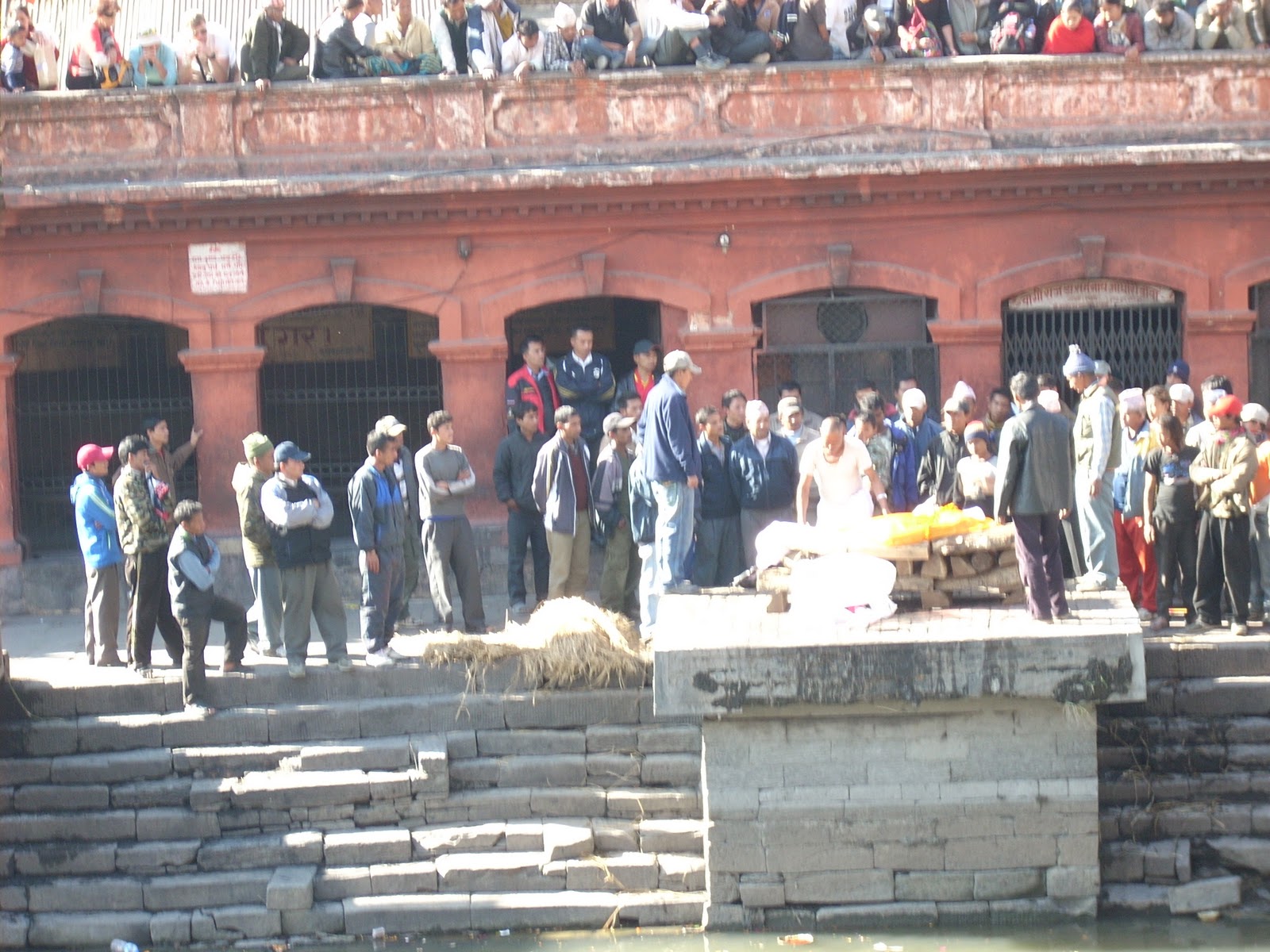
On Saturday afternoon my colleague and I spent several hours among Hindu mourners and ascetics in the Holy City of Pashupatinath observing several Hindu cremation ceremonies.  These take place daily along the Baghmadi River which is a tributary of the famous Ganges River of India.  Several fresh funeral pyres were lined up along the river and periodically, families arrived carrying a recently deceased relative all rolled up in plastic sheeting. After performing several rituals, they laid the body, wrapped in an ocre robe, onto a pyre. A male family member then circled the pyre three times and lit the pyre, starting near the head of the deceased.  After about 10 minutes, flames covered the pyre and smoke spread across the entire area.  And of course one couldn't help inhaling some of the smoke - a rather bizzare thought!  After the fire had fully consumed the body, the ashes were swept into the Baghmadi and slowly floated towards the Ganges.   Although it was all very surreal to me, the locals took it completely in stride.  Kids were even swimming in the river among the ashes. I saw one boy paddling in a casket which I was told was probably used to carry someone from a distant town to the cremation site.  People from nearby towns don't use caskets but only the yellow plastic sheeting.

Funeral pyre at Pashupati
Hindu ascetics at Pashupati

The ascetics, which probably included a few eunichs, were really an exotic lot, having spread ash and various color tones  over their faces and bodies.  They sustain themselves from alms and from donations from tourists who take their pictures.  They are outwardly friendly but completely otherworldly.  And I wouldn't be surprised if a little opium or other local narcotic didn't contribute to their state of mind.  As the Germans say "andere Laender, ander Sitten" -- other countries, other customs.  The world really does have great diversity!

 Pashupatinath was extremely interesting in its own right.  As a non-Hindu, I wasn't allowed to go into the temples but could walk through the streets and look into temples through the doorways.  Many pilgrims were present as were a few "holy cows."


Here are a couple of related links: 

http://www.sacred-destinations.com/nepal/kathmandu-pashupatinath.htm

http://www.kamat.com/indica/culture/death/fig006.htm

http://www.religionfacts.com/hinduism/practices/sadhu.htm

http://www.csuchico.edu/pub/inside/archive/99_02_11/top_story2.html

http://www.worldofstock.com/closeups/PFR2121.php

Over the weekend I visited two other UNESCO heritiage sites -- the ancient Hindu temple city of Bhaktapur (http://www.molon.de/galleries/Nepal/Bhaktapur) and the large Buddhist Stupa of Bhudanat ((http://en.wikipedia.org/wiki/Bodhnath) which is very close to my hotel. In the foregoing link, note the eyes staring down from all angles of the Stupa as well as from surrounding pinnacles and posts. These eyes are one of Nepals most endearing symbols and are common on hats, t-shirts, bumper stickers, etc.

Hindue temple in Bhaktapur


Street scene in Bhaktapur


Bhoudanat Stupa in festive mode
Buddhist Monks at Bohudanat Stupa


Here is an interesing post on the history/legend of BoudhaNath -- please note: there are many different English spellings from the Nepalese transliteration -- (http://www.meroguff.com/2007/02/boudhanath-stupa-place-where-i-live.html).


A few more general comments on Nepal:  it is one of the poorest countries in Asia and because it was never colonized inherited very little infrastructure.  Electricity goes out several times a day and all of Kathmandu's petroleum is brought in from India on large tanker trucks which must navigate the horrible Nepalese roads.  It is very isolated and has few resources.  The major source of income is the tourists that come to trek in the Himalayas or to climb Mt. Everest.  (I didn't get very close to the Himalayas during my time here but I could see the snow-capped peaks in the distance which are truly impressive).

I'm supposed to be traveling to Phnom Penh Cambodia via Bangkok on Thanksgiving Day but it looks like I may be stuck in Kathmandu a while longer. You may have heard that the Bangkok Airport has been closed due to major political demonstrations.  If I am unable to leave tomorrow I'll be looking for alternative ways out which won't be easy from this isolated country.  I may have to bypass Cambodia completely and fly to Jakarta via Hong Kong which would be my last stop before returning to the U.S.

Happy Thanksgiving and have lots of turkey for me.

Tuesday, November 18, 2008

a Q without a U;

 Here's a little trivia for you:  What is the only word in the dictionary that starts with the letter "Q" and is not followed by a "u."  Well,  of course, it's Qatar -- pronounced KA-tahr --  an Arab emirate on a small peninsula jutting out into the Persian Gulf from the North side of Saudi Arabia (http://encarta.msn.com/map_701510187/arabian_peninsula.html).  I'm currently in the Qatari capital of Doha where I'll be until Friday.  Following are a few tidbits of information on Qatar, which may be  more than you want to know.

The current Emir, and one of the richest men in the world, is his Highness Shaikh Hamad bin Khalifa Al-Thani who made news in the US by donating 100 Million Dollars to help New Orleans recover after Hurricane Katrina (http://www.nytimes.com/2008/04/30/us/nationalspecial/30emir.html).  According to wikipedia, Qatar has the 4th highest per capita GDP in the world, based on oil in part, but more importantly on its tremendous reserves of natural gas (http://en.wikipedia.org/wiki/Qatar).

Although I've only been in Doha a day and a half, my impressions are that the city is trying very hard to compete with nearby Dubai in terms of prominence and prestige in the Gulf.  http://www.qatarvisitor.com/index.php?cID=417&pID=1125. There is certainly a lot of construction and opulence here but nothing close to what I've seen in Dubai.  However one area where Doha may have outdone Dubai is in the area of Islamic art.  A new Islamic Art museum, designed by I. M. Pei, and which is being heralded as one of most important Islamic Art museums in the world has just been completed.  Unfortunately I won't be able to see it as it won't open its doors to the public until next week when I'll be gone.  http://www.skyscrapercity.com/showthread.php?t=314423.

Sunday, November 16, 2008

Oman: right out of 1001 Arabian Nights

http://www.arabiantales.org

Where am I?  - Muscat in the Sultanate of Oman
Map:  http://encarta.msn.com/map_701510187/arabian_peninsula.html

Who's in charge?  Sultan Qabos bin Said al Said (http://en.wikipedia.org/wiki/Qaboos_of_Oman).  By Middle Eastern standards, he's a very enlightened ruler who has had great success in developing the country despite much lower oil revenues than the nearby UAE and Saudi Arabia.  He has been divorced twice, doesn't have an heir, loves Western classical music and lives a very secretive life.  Expats and Wikipedia suggest he is gay; his subjects deny it.  He is currently building one of the largest opera houses in the Middle East.

Where am I staying: Muscat Intercon -- http://www.ichotelsgroup.com/intercontinental/en/gb/locations/overview/MSCHA

What do I think?  It truly doesn't get much more exotic than Oman?  The Imams are now calling the faithful to prayer and I'm sure I've already seen Ali Baba, Sinbad, Aladdin, Scheherazadah and Ibin bin Saud roaming the streets or peering down from some of the many forts throughout the Sultanant. By Muslim standards, it is a very tolerant place -- one can get a drink after 6 in the hotel bar and there are several churches, although apparently no synagogues.

What have I been up to?  Working most of the time and spending the weekend (Thursday/Friday) touring and in conversation with Sauod, my guide.   

Highlights:

1) Incredible forts, perhaps the most of any country outside Europe, which I had not expected --  http://www.saudiaramcoworld.com/issue/198303/oman-the.forts.htm
The two most impressive ones I saw were: Fort Nakhl -- http://au.encarta.msn.com/media_1201500677_761579203_-1_1/fort_nakhl_oman
and Fort Rustaq -- http://brigittainoman.blogspot.com/2008/06/rustaq-fort-may-2008.html

Fort Nakhl - Oman
2) Vast acres of date palms -- Oman has hundreds of date sorts, considered to be among the best in the world and the country's most important export.  I'm not generally a big fan of dates but I really do like some of the ones I've tasted here;

3) High, rugged mountains in the Sultanat's interior.

4) The city of Muscat which is a picturesque blend of old Arabic and modern buildings, walls, forts, and mosques.  http://www.greatmirror.com/index.cfm?navid=750&picturesize=medium

4) Extensive conversations with Sauod, my tour guide: some of his surprising, often unsoliticited comments follow:

Within the first hour we were together he told me that he is not very religious, even though he prays 5 times on most days, goes to Mosque on Fridays and follows most normal Islamic practices (I sensed he was much more willing to admit this to an "infidel" than to a fellow Muslim).  And He  admitted that the pressure to conform is tremendous in this part of the world.  He said that he occasionally drinks wine or smokes socially but without the knowledge of his wife or children who are religious and would be very dissappointed.  He envies Westerners who he believes have an easier time blending religious and secular life.  He believes in Allah but thinks Christians and Jews are as likely to go to heaven as Muslims. But he doesn't like Zionists! 

As is very common in the Arabic world, his wife is the daughter of his mother's sister. He wanted to marry her from the time they were children and did so at his initiative and not because his parents told him to.  He worries alot about his oldest son who is a nice boy but has no goals or ambition. He doesn't worry much about his daughters.

He thinks it would be much easier in the West to be friends with ones children when they grow up.  He says Muslim men must continue to play the father role when their children are adults and have a tremendous fear of showing their real selves or any weakness.  He admitted that there is quite alot of hypocrisy in Muslim society (as there is in the West).

He enjoys the company of Westerners but detests George Bush.

Addendum: 8 March 2011:  An interesting article in today's New York Times about the Sultan

Saturday, May 10, 2008

The Bulgarian Mafia

Since arriving in Sofia I have heard a lot of  talk about a powerful Mafia presence in Bulgaria. And one sees the evidence everywhere which include lots of tough looking guys sitting around in hotel lobbies and restaurants and large black luxury vehicles such as BMWs, Mercedes and Hummers with black tinted windows cruising the streets.  

On Sunday I had a first-hand Mafia experience: I decided to have lunch at an attractive outdoor cafe and sat down across from two stereotypical mafia guys who I initially didn't pay much attention to.  They looked almost identical, both having close-cropped hair, dark sunglasses, black leather jackets, jeans and boots.  For most of an hour they sat drinking coffee, smoking cigarettes, talking on their cellphones and surveying the area while hardly speaking to each other.  On the other side of me, parked illegal at the curb, was a shiny black Mercedes SUV with tinted windows.  All of a sudden one of the guys called the waitress and asked for the bill.  After quickly paying, they started to move towards the SUV when one of them paused sharply and went back to the easy chair he had been sitting in.  I watch as he reached into the side of the chair, took out a large pistol and tucked it under his jacket and into his belt.  He had apparently placed it into the side of the chair because it was uncomfortable while he was sitting.  He suddenly remembered it and went back to get it.  He noticed that I was watching but ignored me.  The two of them then quickly drove away. It was a scene straight out of the Bulgarian version of the Sopranos!

Below are a few links related to the Bulgarian mafia.

  http://news.bbc.co.uk/2/hi/europe/7337210.stm

On Saturday I took a half day trip away from Sophia to the impressive Rila Monastery, a UNESCO world heritage site stemming back to the 10th Century, and one of the most impressive monasteries  I've seen.  The following link contains the history and some pictures of the monastery.

http://www.bulgarianmonastery.com/rila_monastery.html


Friday, May 2, 2008

In Bratislava

I arrived in Bratislava, the Slovakian Capital, late last night from Kiev after a missed connection in Prague and a five hour layover.  It was a long day and I wasn't a happy camper. When I have days like yesterday I think I should give up traveling.  And when I have days like today, I'm glad I'm still doing it.

Bratislava is only an hour from Vienna and not far from Budapest.  It was formerly called Pressburg and had large German and Jewish communities.  I had heard of Pressburg before but had no idea that it was modern day Bratislava, the capital of Slovakia.  The Jewish population today is about 800 out of a total of 400,000+ of which 90% are said to be Slovak. 

http://www.chatamsofer.com/ is a website which tracks the Jewish history of Bratislava.  Tommorow, May 1, is the European Labor Day Holiday which I will have off and use to tour the city.  I will also see what Jewish sites I can find along the way, perhaps the Jewish Museum if it is open on the holiday. 

My hotel is next door to the embassy which is right in the heart of this very attractive city.  The city fathers have spent a lot of money since the breakup of the Communist Bloc to restore old buildings and to spruce things up. They have a beautiful old Opera House and apparently a very active theater and cultural scene.  Most of the narrow streets in the city center are for pedestrians only  and are filled with lots of outdoor cafes and restaurants.  It is typical of the cafe society one finds in most of the old cities of Central Europe. People sit in the cafes for hours visiting and drinking cafe, wine or beer while musicians play in the squares for tips.  I must say it is very pleasant, especially when the weather is nice as it was today, I only wish that Gertrud and a few friends were here to share it with me. 

The wikipedia page below has a lot of information on Bratislava's culture and history.

http://en.wikipedia.org/wiki/Bratislava